Wednesday, November 18, 2009

Tokyo Night Views

Tokyo is one of my favorite cities in Japan. It's clean, safe and full of energy. Just like other big Japanese cities, it may seem dull during the day. But when the sun sets, the whole city transforms into a sea of lights filled with neons competing to get your attention. Here are some of the shots I had taken from different places in Tokyo at night.

Tokyo Tower and Rainbow Bridge from Odaiba (taken on February 10, 2008)

Fuji TV and Aqua City in Odaiba (taken on February 10, 2008)

Ebisu Garden Place (taken on July 5, 2008)

Roppongi Area from Tokyo Tower (taken on March 9, 2008)

Shibuya Crossing (taken on December 23, 2007)

Shinjuku (taken on December 23, 2007)

Odaiba Area from Tokyo Tower (taken on March 9, 2008)
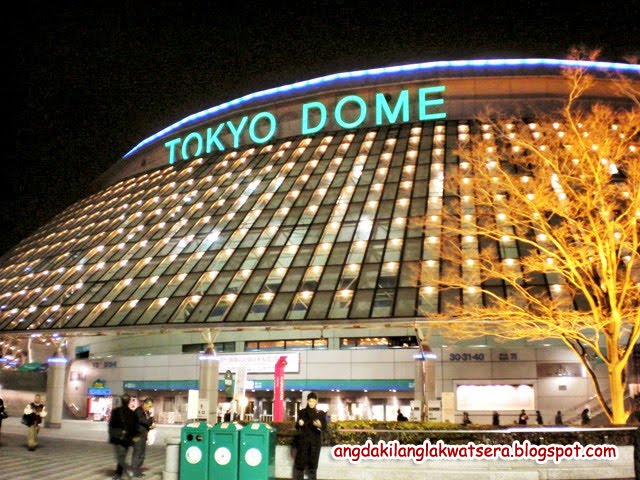
Tokyo Dome (taken on March 1, 2008)

Tokyo Tower from Roppongi Hills (taken on June 28, 2008)

Tokyo Tower From Below (taken on March 9, 2008)

Some places to see Tokyo's night views:

1) Tokyo Tower
Entrance Fee: 820yen to main observatory; 600 yen from main to special observatory
Operating Hours: 9:00am - 10:00pm
Access: Please refer to link above

2) Roppongi Hills
Entrance Fee: 1500yen
Operating Hours: 9:00am - 1:00am (last entry is 12:00am)
Access: Please click here

3) Tokyo Metropolitan Government Building
Entrance Fee: FREE
Operating Hours: 9:30am - 11:00pm (last entry is 10:30pm)
Access: Shinjuku station (JR, Tokyo Metro, Toei Lines, etc.)

4) Odaiba Seaside Park
Entrance Fee: FREE
Operating Hours: ANYTIME
Access: Shinkotsu Yurikamome Line Odaiba Kaihin Koen Station or Daiba Station / Sea Bus Odaiba Kaihin Koen Stop
Read more...

Thursday, November 12, 2009

Off To Albay

After a whole day in CWC, my friends and I spent the 2nd day of our Bicol weekend getaway in Albay. We left CWC early in the morning and since our friend's aunt lent us her van and driver, we just sat back and relaxed until we arrived in Albay around 2 hours later. Our first stop in Albay - the Cagsawa Ruins.

The Cagsawa Ruins is what remained of the church of Cagsawa after the Mayon Volcano erupted and engulfed the whole town in 1814. Now, this place is a primary tourist spot as it is one of the best places to view the star of Albay - the majestic Mayon Volcano. Unfortunately for us, we were not able to see the perfect cone shape of Mayon as it was a cloudy day. We were told that if we wanted to see the whole of Mayon, we should get there as early as 6 or 7am. Oh well, better luck next time.

Cagsawa Ruins (taken on November 17, 2007)

After Cagsawa Ruins, we proceeded to another famous place in Albay - the Hoyop Hoyopan caves. Hoyop is Bikolano for "ihip" or "blow". True enough, it was breezy inside the cave. This cave is famous for its stalactite formations and it is another good place to view the Mayon Volcano.

Hoyop Hoyopan Caves: "Skull" (taken on November 17, 2007)

Hoyop Hoyopan Caves: "Moses" (taken on November 17, 2007)

Hoyop Hoyopan Caves: "Elephant" (taken on November 17, 2007)

Hoyop Hoyopan Caves: "Skull" (taken on November 17, 2007)

Since we had time before heading back to Naga, we stopped by Busay Falls. Busay falls is not as popular as Mayon or the Hoyop Hoyopan cave, but it is a great place to relax and enjoy nature. It sure was a great way to end our Albay daytrip.

Busay Falls (taken on November 17, 2007)

Finally, we bid farewell to Albay and made our way to Naga to catch the 9pm bus of Penafrancia back to Manila. If you're riding Penafrancia, I recommend riding its Comfortec Bus. Just add 100 pesos on the regular fare and you can sleep comfortably throughout the 8-hour journey.

Access to Legazpi, Albay (from Manila):
a) By bus: Several bus companies such as Penafrancia, Victory Liner, Isarog Lines take the Manila-Legaspi Route daily.
b) By plane: Companies such as Philippine Airlines, Cebu Pacific and Zest Air have regular flights to Legaspi from Manila.

Access to Legazpi, Albay (from Naga):
Upon arrival in Naga, you may ask around for buses or vans taking the Naga-Legazpi route. Travel time is around 2 hours.

Costs:
a) Entrance fee Hoyop Hoyopan cave: 20php
b) Entrance fee Cagsawa Ruins: 10php
Read more...

Tuesday, November 3, 2009

CamSur Watersports Complex

Around this time 2 years ago, my friends and I decided to head to Bicol for a weekend getaway. Since this was my first time to go to the Bicol region, I was so excited. We decided to head first to Camarines Sur to try out wakeboarding and spend the next day going around Albay.

We departed from Manila on Friday night via Penafrancia Bus to Naga, the capital of Camarines Sur. After around 8 hours of travel, we finally arrived in Naga terminal where we were picked up by a shuttle which brought us to Camarines Sur Watersports Complex or CWC.

Upon arrival, we checked in and proceeded to the man-made lake for wakeboarding. Since we were all beginners, we started with kneeboarding. Unfortunately, towards the end, I was not able to graduate from kneeboarding. I could not even complete one round. Yeah I really need to practice hard! hahaha. Even if my arms hurt from all the wakeboarding, it was such a great experience and I would really recommend it.

Wakeboarding in CWC (taken by my friend on November 16, 2007)

Kneeboarding - beginners stage (taken by my friend on November 16, 2007)

After a whole day in CWC, we went to Naga City for dinner and some late night coffee bonding. After a while, we decided to head back to CWC and called it a day.

Access to Naga (from Manila):
a) By bus: Buses such as Penafrancia, Victory Liner, etc take the Manila-Naga route.
b) By plane: Philippine Airlines, Cebu Pacific Air, Zest Air have regular flights to Naga.

Costs:
You can check out the updated rates at Camarines Sur Watersports Complex's website
Read more...

Thursday, October 22, 2009

10 Hours In Macau

Last February, I went to Macau with my friends who are living in Hong Kong. We took the ferry from Hong Kong to Macau and arrived at around 12noon. From the port, we took a free shuttle to the Venetian where my friend and I met up with our other companions. Then, we all took the taxi to Senado Square where we started our Macau exploration.

Most of the attractions of Macau are contained around the Senado Square area. Some of the places we visited included the St. Dominic Church and the very famous St. Paul Cathedral ruins. There are many shops and food stalls around this area so you won't get hungry. Trust me :D

St. Paul Cathedral Ruins (taken on February 7, 2009)

St. Dominic Church (taken on February 7, 2009)

After walking around Senado Square, we got hungry. So we chose to eat in A Lorcha, a Portuguese restaurant recommended by a friend. But when we got there, lunch time was over. So we had to return during dinner time. Luckily we were able to get a reservation since they were almost fully booked for the night. While waiting for dinner, we just decided to go to Macau Tower. Aside from the magnificent view the tower has to offer, Macau Tower is also home to AJ Hackett Macau Tower which is the highest bungee in the world. None of us jumped but we watched people jump while eating the pork jerky we bought in Senado Square. What a great way to relax! Hahaha!

Macau Tower (taken on February 7, 2009)

Bungeeeeee (taken on February 7, 2009)

Bungee!!! (taken on February 7, 2009)

View From Macau Tower (taken on February 7, 2009)

Outside Macau Tower (taken on February 7, 2009)

At around 5:30pm, we returned to A Lorcha. While waiting for dinner time, we went to A-ma Temple which is a few steps away from the restaurant. This was also a great place to catch the beautiful sunset of Macau.

A-ma Temple (taken on February 7, 2009)

Sunset by A-ma Temple (taken on February 7, 2009)

Then we had our much awaited A Lorcha meal, and it did not disappoint. The waiter recommended we have clams, prawns, Portuguese fried rice and lamb. The food was delicious and the staff are mostly Filipinos so they really took care of us. But if you plan to eat in A Lorcha, make advanced reservations as it is almost always full. You can contact them at +853 313 193. It is located at 289 Rua do Almirante Sergio, Macau. As it is a very famous restaurant, you can ask people around for directions.

A Lorcha (taken on February 7, 2009)

Prawns (taken on February 7, 2009)

Lambchop (taken on February 7, 2009)

Portuguese Fried Rice (taken on February 7, 2009)

Prawns (taken on February 7, 2009)

After our meal, we went to the Venetian, explored for a bit, then rode the bus back to the port.

Inside The Venetian (taken on February 7, 2009)

We left Macau at around 10pm and went back to Hong Kong via ferry.
Read more...

Wednesday, October 14, 2009

Typhoon In The Middle Of Summer

Around three weeks ago, typhoon Ondoy (Ketsana) struck Metro Manila and its nearby provinces flooding most of the country's capital. A week after Ondoy, typhoon Pepeng (Parma) made landfall in Northern Luzon killing dozens and destroying crops and infrastructures. When everybody thought typhoon Pepeng already left the country, it made a U-turn and hit the provinces of Northern Luzon once again causing great floods, landslides and killing hundreds of people. These circumstances reminded me of another flood and typhoon experience earlier this year. During the "summer" month of May (when it was supposed to be sunny and dry), we were greeted with typhoon Dante (Kujira) during our trip to the Bicol Region.

During that time, the Philippines was celebrating the Labor Day long weekend. Being summer and all, my friends and I planned to spend it in the beautiful Bicol region. Our initial plan was to spend one day in the butanding (whale shark) capital of the Philippines, Donsol and 2 days in the beautiful Caramoan Islands in Camarines Sur. We were expecting sunny weather since techinically it was still summer. However, a day before departure, we heard that there was an active low pressure area near the Bicol Region. Since we have already prepared for this and we had already bought our bus tickets, we decided to push through hoping it would be just a false alarm. But we were wrong.

Thankfully during our first day, the rain stopped for a while so we were able to push through with our butanding watching. We were lucky because even if the weather was not good, we were still able to spot 2 whale sharks. However, our guide told us that on a fine day, you can spot as much as 20 whale sharks. Butanding watching season is said to be from February to June, but the best time to go is around March to April, with the butanding festival being held around the last week of April every year.

In the middle of butanding watching, heavy rains started to fall. We had no choice but to go back. For the next few days, the rain did not stop. As a result, we were stranded in Donsol for the whole duration of our trip. All flights coming in and going out of Bicol were cancelled. Landslides slowed down traffic in the northern area of the region. And roads going in and out of Donsol were flooded so there was no way for cars and even buses to reach us. Since we were all working, we had to leave Donsol on time. Thank God the rain stopped and we were able to get out of Donsol. But in order to do so, we had to brave 7 floods in Donsol alone since all roads were still flooded. Thankfully, the people in our homestay in Donsol were nice and they sent a guide (Kuya Jay) to help us go out of Donsol. If any one of you is going to Donsol, you can contact Eve's Homestay at +639164155783. We finally got out of Donsol and took the bus out of Bicol from Legaspi City. When we arrived in Manila, we heard from the news that typhoon Dante left 27 dead in the whole Bicol Region and some provinces in the region were placed under the state of calamity.

Braving the floods (taken on May 3, 2009)

Carrying our bags (taken on May 3, 2009)

Boats (taken on May 3, 2009)

Nipa hut near flooded rice fields (taken on May 3, 2009)

Typhoons hitting during the summer season is pretty unusual in the Philippines. I once heard in the news that because of global warming, the Philippines should expect a rainy summer and a even rainier rainy season. Typhoons Dante, Pepeng and Ondoy are just a preview of what the next typhoons will be. If we continue to abuse our environment, we would see worse and deadlier typhoons in the years to come.
Read more...

Wednesday, September 30, 2009

The Wrath Of Ondoy (Typhoon Ketsana)

Over 240 deaths... 4.6 billion pesos worth of damage... 80% of the Philippines' capital and surrounding provinces under water.. That is what Ondoy or typhoon Ketsana did to the Philippines. On September 26, 2009, the typhoon brought over a months worth of rainfall causing the worst flooding Manila and surrounding areas has seen in 50 years.

Here are some images from Time Magazine...


As of today, certain parts of the city are still flooded while thousands are displaced. Many are in dire need of food and supplies so your help is needed. Any kind of help is very much welcome. Here are some ways on how you can send your help. Thank you very much and I am sure your help will be very much appreciated by the Filipino people.


Read more...

Wednesday, September 23, 2009

The Island of Corregidor

The island of Corregidor was used as a military base to prevent Japanese troops from entering Manila Bay during the second world war. However, in 1942, the Japanese defeated the Filipino and American troops and finally took over Corregidor and then Manila. Three years later, Corregidor was regained by the US and Filipino armies and eventually, the Japanese troops were defeated and driven out of the Philippines. This place played a key role in the Philippines' history and this is why it is a must-visit for both Filipinos and foreigners alike.

Mt. Samat from Corregidor (taken on December 30, 2008)

One of the best way to get to Corregidor is by joining tours such as the one operated by Sun Cruises as transportation within the island is limited. Day tour costs 1999php inclusive of boat to and from Corregidor, Corregidor island transportation, tour guide, and buffet lunch. You can also opt to stay overnight and they also have tour packages for that.

We boared the Sun Cruises in the CCP Complex, left Manila at around 8am and after an hour or so, arrived in Corregidor. Our first stop was the Malinta Tunnel. Malinta Tunnel served as the headquarters of Gen. McArthur and seat of government of the Commonwealth. To fully understand the importance of this tunnel, a light and sound show is shown inside the tunnel for an additional fee of 150php.

Outside Malinta Tunnel (taken on December 30, 2008)

Inside Malinta Tunnel (taken on December 30, 2008)

After Malinta Tunnel, we proceeded to the Filipino War Memorial and the Japanese War Memorial. Having a Japanese War Memorial inside Corregidor might be disturbing to some, but there were also many Japanese soldiers who died when the Americans and Filipino troops gained Corregidor back.

Filipino War Memorial (taken on December 30, 2008)

Filipino War Memorial (taken on December 30, 2008)

Japanese War Memorial (taken on December 30, 2008)

After visiting the war memorials, we had our lunch and continued with our tour. We visited some batteries or places where military weapons were placed such as the Battery Way, Battery Hearn and Battery Grubbs. On the way, we passed by some army barracks which were ruined during the war.

Former army barracks (taken on December 30, 2008)

In Battery Way (taken on December 30, 2008)

Cartridge room in Battery Way (taken on December 30, 2008)

In Battery Hearn (taken on December 30, 2008)

Former army barracks near the batteries (taken on December 30, 2008)

Then, we proceeded to the Pacific War Memorial which was built by the US to honor both the Filipino and US armies who fought against the Japanese troops.

Pacific War Memorial (taken on December 30, 2008)

Outside Pacific War Memorial (taken on December 30, 2008)

The last stop of the tour is the Spanish Lighthouse which offers a nice view of the island.

Spanish Lighthouse (taken on December 30, 2008)

Corregidor is just around an hour away from Manila, but it was not until December last year that I visited this island. I wish I had visited this place earlier. But as they say, better late than never.

Our Itinerary:
0800: Left via
Sun Cruises in CCP
0915: Arrived in Corregidor

0950-1030: Malinta Tunnel
1045: Filipino War Memorial
1115: Lunch
1210: Battery Way, Battery Hearn, Battery Grubbs, ruins
1310: Pacific War Memorial Museum
1350: Spanish Lighthouse
1430: Left Corregidor
1545: Arrived in Manila

Cost: 1999php inclusive of tour guide, transportation, lunch buffet, boat to and from Corregidor. Additional 150php for the light and sound show in Malinta Tunnel.
Read more...